Case type Utility Injuries & Property Damage
Utility-Caused Wildfires
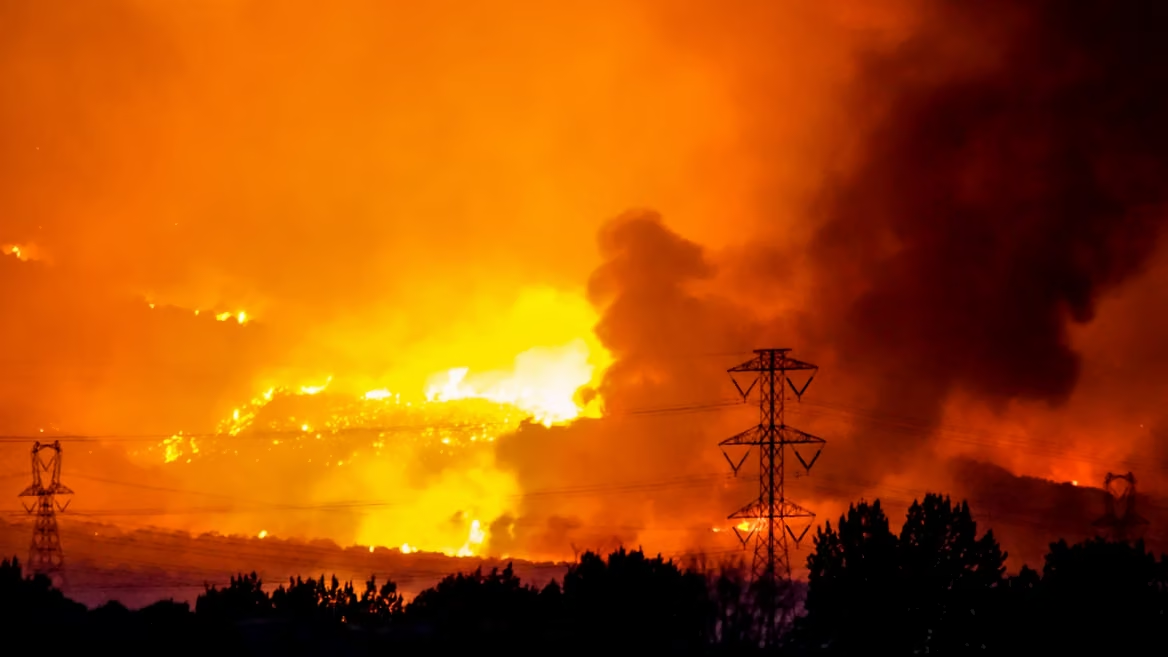
Lost a home, a business or a loved one in a wildfire that may have started at a power line? Tell us your story.
This page is for people who were injured, evacuated, or lost homes, land or businesses in a wildfire that may be linked to electrical equipment. CBW Law reviews what is known about the fire's cause, your losses and the rules in your state. Tell Us Your Story. Contacting us does not create an attorney-client relationship.
Some of the deadliest wildfires in recent U.S. history have been traced to electrical equipment. A spark from a damaged line, a failed piece of hardware or a branch touching a conductor can ignite dry fuel, and wind can turn that ignition into a disaster within hours. Not every fire near a power line was caused by one, and suspicion is not proof. A wildfire lawyer separates what investigators have actually found from what is still alleged, and explains how the rules in your state treat utility-caused fires.
How electrical equipment can start a wildfire
Power lines and equipment can ignite fires in several ways. Official investigations of recent fires describe many of them:
- Broken or downed lines that throw sparks when re-energized, as Maui investigators found in Lahaina3
- Electrical arcing on towers or hardware, as Los Angeles County investigators found in the Eaton Fire2
- Failed or decayed poles that drop lines onto dry grass, as Texas investigators found in the Smokehouse Creek Fire11
- Transmission equipment failures, as CAL FIRE found in the 2018 Camp Fire4
- Lines swinging loose in high wind, a factor cited in Colorado's Marshall Fire7
- Trees and vegetation contacting conductors
Contributing factors: vegetation, equipment and maintenance
Investigators and courts often look at conditions that existed before the fire started:
- Overgrown or unmaintained vegetation near poles and lines3
- Aging, decayed or out-of-service equipment that remained in place211
- Inspection and repair records, including known problems that went unfixed
- Decisions about shutting off power during extreme wind
- How quickly lines were de-energized after damage
These factors help explain how a fire started. Whether they amount to negligence or legal liability is a separate question that depends on the evidence and the state's law.
How investigators determine a wildfire's origin and cause
Wildfire investigators work backward from the burn pattern to find where the fire began, then examine what could have ignited it there. The National Wildfire Coordinating Group publishes a guide that encourages a systematic approach to these investigations1. Los Angeles County used that methodology in the Eaton Fire, working with CAL FIRE and outside electrical and metallurgical experts for 18 months2.
Several agencies may investigate one fire: local fire departments, state forestry agencies, federal agencies such as ATF, utility regulators and prosecutors23. Their reports can take a year or more, and some are partly redacted while criminal reviews continue2.
What official investigations have found
-
May 2019
CAL FIRE determines PG&E transmission lines caused the 2018 Camp Fire4. PG&E later pleads guilty to 84 counts of involuntary manslaughter5.
-
June 2023
Boulder County concludes the Marshall Fire had two ignition sources, one of them sparks from an Xcel Energy power line67.
-
October 2024
Maui County and ATF report the Lahaina fire started when re-energized broken power lines ignited unmaintained vegetation3.
-
August 2026
Los Angeles County reports the Eaton Fire was caused by electrical arcing on an out-of-service Southern California Edison tower2.
Utility wildfires in high-risk states
Wildfire risk and the law both differ by state. These are the states where utility-linked fires have drawn the most official findings and litigation, along with rules that apply there.
California
California courts have allowed inverse condemnation claims against privately owned utilities whose equipment caused damage, a theory that can make a utility responsible for property damage without proof of negligence13. The state also created a Wildfire Fund in 2019 to help pay claims from covered utility-caused fires14, and in 2025 enacted SB 254 to create its next generation15. Recent fires include the Camp Fire4 and the January 2025 Eaton Fire, which killed 19 people and destroyed or damaged more than 9,000 homes and businesses2. The United States has also sued Southern California Edison over the Eaton Fire, alleging negligence21.
Colorado
The December 30, 2021 Marshall Fire burned through Boulder County. Investigators found sparks from an Xcel Energy power line were one of two ignition sources7. In September 2025, Xcel agreed to a $640 million settlement on the eve of trial without admitting fault8. Colorado generally allows two years for tort claims24, and claims against public entities require written notice under the Governmental Immunity Act25.
Hawaiʻi
The August 8, 2023 Lahaina fire took at least 102 lives. Maui County and ATF found it began near a utility pole when re-energized broken lines ignited vegetation, and that the morning fire rekindled in the afternoon wind3. In 2024, state officials announced a global settlement in principle of more than $4 billion to resolve the wildfire lawsuits12. Hawaiʻi generally allows two years for injury and property claims26.
Oregon
In June 2023, a Multnomah County jury found PacifiCorp liable in a class action over fires during the 2020 Labor Day windstorm9. Claims against Oregon public bodies have their own notice rules27.
Texas
The Smokehouse Creek Fire of February 2024 became the largest wildfire in state history. Texas A&M Forest Service investigators found it started when a decayed pole snapped and dropped Xcel lines onto dry grass11. The state has sued the utility10. Texas generally allows two years for personal injury and property damage claims28.
Other western states
Several states have passed laws on utility wildfire mitigation plans that can affect how claims are handled, including Utah in 202016 and Idaho's 2025 Wildfire Standard of Care Act17. These laws change the legal standards and procedures, so local rules must be checked for every fire.
A fire's cause is a finding made from evidence. Until it is made, a utility's role is a question, not an answer.
Injuries, smoke, evacuation and displacement
Wildfires injure people directly through burns and smoke, and indirectly through rushed evacuations and lost homes. CDC notes that wildfire smoke can cause coughing, trouble breathing, asthma attacks, chest pain and a fast heartbeat, and that people with heart or lung disease, pregnant people and children face higher risk18. Smoke can travel far from the fire itself18.
- Burns and smoke inhalation, sometimes requiring burn center care
- Injuries during evacuation
- Worsened heart or lung conditions
- Emotional trauma after losing a home or community
- Long periods of displacement and temporary housing
When a fire is fatal, families may have wrongful death claims. Burn injuries are covered on our Severe Burn Injuries page.
Property and business losses a claim may include
Depending on the state and the facts, a utility wildfire lawsuit may seek compensation for:
- Homes and other structures
- Personal belongings
- Trees, landscaping and fencing
- Vehicles and equipment
- Additional living expenses
- Business interruption and lost profits, where the law allows
- Cleanup and debris removal
- Uninsured and underinsured losses
Some states have special rules for timber and tree damage, and some limit certain categories of loss. No amount can be promised.
Insurance claims and claims against a utility
A homeowners policy usually includes coverage for the dwelling, belongings, additional living expenses and liability19. Filing an insurance claim is usually the first step, and it does not by itself prevent a separate claim against a responsible party.
- Insurance may not cover your full losses, especially if you were underinsured.
- Your insurer may pay you and then pursue the utility for what it paid.
- A claim against the utility may seek losses insurance did not cover.
- Settlements and fund rules may require you to account for insurance payments.
Keep every letter from your insurer and adjuster. How insurance payments interact with a claim depends on state law and on any settlement program that applies.
Individual claims, coordinated proceedings and settlements
After a large fire, hundreds or thousands of people may file claims. Courts often coordinate them before one judge. Oregon's PacifiCorp case proceeded as a class action9. Colorado's Marshall Fire cases were set for trial in Boulder County before the settlement8. In Hawaiʻi, the Maui claims were resolved through a global settlement12. Each person's losses still have to be documented, even in a group case.
Documenting your wildfire losses
Do not return to a burn area until officials allow it. Documentation can start from home, with photos on your phone, cloud backups and bank records.
Records and evidence to keep
The fire and evacuation
- Evacuation orders, alerts and texts
- Photos and video of the fire or smoke you saw
- The date and time you left and where you went
- Names of neighbors and witnesses
Property
- Before-and-after photos of the home and land
- A room-by-room inventory of belongings20
- Receipts, appraisals and purchase records
- Repair and rebuilding estimates
Insurance, business and health
- Your policy and all insurer correspondence
- Hotel, rental and meal receipts
- Business tax returns, sales records and payroll
- Medical records for burns, smoke or stress-related care
Do not remove debris before documenting it
If cleanup is scheduled, photograph your property first. Never enter a restricted area, and do not disturb utility equipment, which may be evidence in an ongoing investigation.
Ready.gov recommends keeping insurance policies and personal documents up to date and making copies before fire season29.
Filing deadlines for a utility wildfire claim
Deadlines vary by state and by who owns the utility. California generally allows two years for injury or death22, but claims against a public entity, such as a municipal utility, must be presented within six months23. Colorado allows two years for most torts24, Hawaiʻi two years26 and Texas two years28. Notice requirements for public bodies apply in Colorado25 and Oregon27. Property and inverse condemnation claims may follow different periods.
Settlement programs and coordinated cases can add their own registration or claim deadlines. Ask about timing early, even while the cause is still under investigation.
What happens after you contact CBW Law
How a wildfire claim review works
-
You tell us what happened
Share which fire, where your property was, and what you lost or how you were hurt.
-
We check the cause findings
We review what investigators have found and what remains unresolved.
-
We look at your state's rules
We identify deadlines, notice rules and any settlement programs that may apply.
-
We explain what we see
We tell you plainly whether we think a wildfire claim may be possible and how insurance fits in.
Power lines can also injure people directly. See Downed Live Wire & Electrocution Injuries, or return to our Utility Injuries & Property Damage overview.
Plain English
Medical, Health & Insurance
Fire reports, insurance forms and court papers use terms you may not know. Here are some.
Fire investigation terms
Health terms
- Smoke inhalation
- Breathing smoke, which can cause coughing, wheezing and chest pain18.
- Fine particles
- Tiny particles in smoke that can reach deep into the lungs.
Insurance and legal terms
- Additional living expenses
- Coverage for extra housing and living costs while your home cannot be lived in19.
- Subrogation
- An insurer's effort to recover what it paid from the party that caused the loss.
- Inverse condemnation
- A claim for damage to property caused by a public use, which California courts have applied to utility equipment13.
- Coordinated proceeding
- Many related cases managed together before one judge.
Questions
Frequently asked utility wildfire questions
Short answers to questions people ask after a wildfire.
Does insurance prevent another claim?
Usually not. You can file with your insurer and still pursue a claim against a responsible party for losses insurance did not cover. Your insurer may also pursue the utility for what it paid.
What if I rent?
Renters can have claims for their belongings, displacement costs and injuries. Keep your lease, renter's insurance papers and receipts.
What if the cause remains under investigation?
You can still document losses and get advice on deadlines. Investigations can take a year or more2, and deadlines may run in the meantime.
How do I document losses?
Make a room-by-room inventory using old photos, receipts and bank records20. Keep evacuation notices and every insurer letter.
Do I need a utility wildfire lawyer if there is already a settlement?
Settlement programs have their own rules and deadlines. A wildfire lawyer can explain how a program works and whether it fits your losses.
Can I file a wildfire lawsuit if I was only evacuated?
It depends on your losses. Evacuation costs, smoke-related illness and business interruption may be part of a claim in some cases.
Is a lawsuit against a utility the same in every state?
Can I get compensation for burned trees and landscaping?
Often, yes, though the rules for measuring tree and landscape damage vary by state.
How much does it cost to talk to a wildfire attorney at CBW?
Telling us your story costs nothing, and contacting us does not create an attorney-client relationship.
Tell Us Your Story
Recovering from a wildfire is long and exhausting. Understanding whether a utility may be responsible starts with the official findings and your own records.
If you lost a home, business or loved one, or were hurt or displaced by a fire that may be linked to electrical equipment, tell us what happened. CBW Law will review your information and explain what we see. Submitting information does not create an attorney-client relationship or guarantee representation.
Tell Us Your Story Call (800) 476-2416
This page is general information about wildfires linked to electrical equipment. It is not legal, insurance or medical advice and does not create an attorney-client relationship. A fire near a power line, an allegation or a lawsuit does not, by itself, establish that any utility caused a fire or is legally responsible. Laws and deadlines differ by state, and no outcome can be promised. Follow evacuation orders from local officials.
