Case type Occupational Disease & Toxic Exposure
Welding Fume & Manganese Exposure
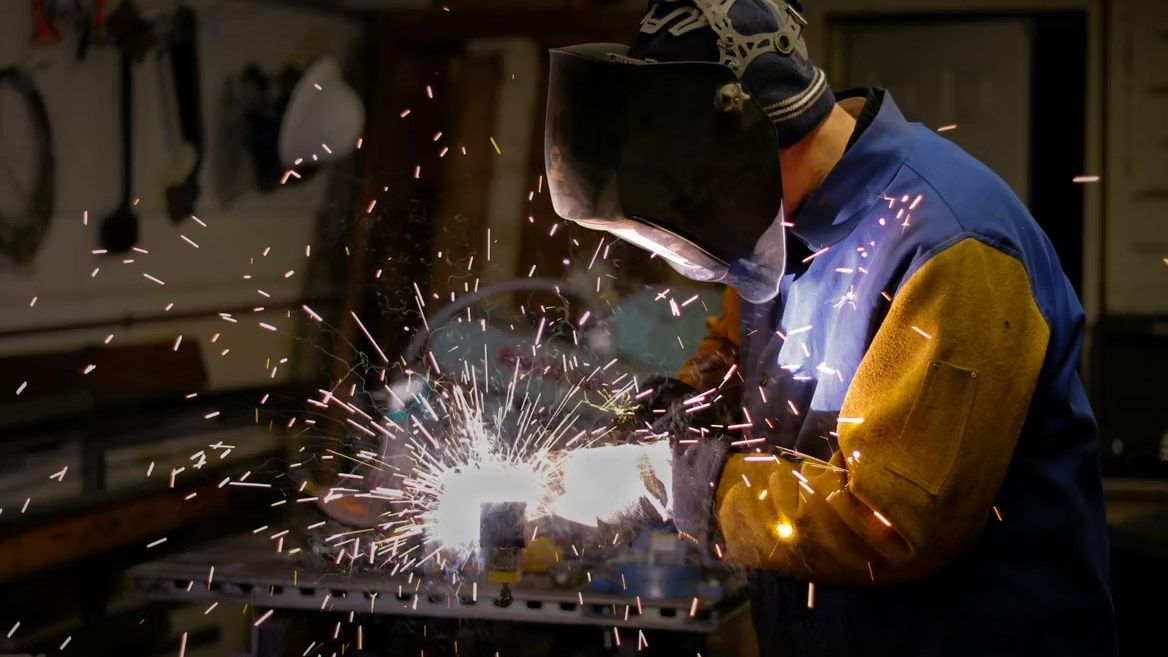
A welder with tremors, stiffness or lung problems? Tell us your story.
CBW Law reviews claims from welders and metal workers harmed by welding fume and manganese exposure. Tell Us Your Story. Contacting us does not create an attorney-client relationship.
Welding fume is a mix of metals and gases whose makeup depends on the process, the rods and wire, the base metal and any coatings. Manganese in fume can affect the nervous system, and long exposure has been linked to a parkinsonian condition called manganism. Welding fume is also studied for lung disease and cancer. A welding fume lawyer starts with what was welded, with what, and where.
What is in welding fume
Fume content depends on the welding process, base and filler metals, rod composition, coatings, location and ventilation1. Welding can create hexavalent chromium, and coatings add their own hazards1. Most welding fumes contain a small percentage of manganese2. About 11 million workers worldwide hold welder job titles, and about 110 million more probably have welding-related exposure3.
Manganese and the nervous system
The body normally gets rid of extra manganese from food, but manganese that is breathed in bypasses those defenses and can build up and damage the lungs, liver, kidneys and nervous system2. Prolonged exposure to high levels can lead to a parkinsonian syndrome known as manganism2. Manganism combines behavioral changes with slow, clumsy movements4.
Lower exposures matter too. NIOSH notes studies linking low-level manganese exposure to poorer results on tests of mood, short-term memory, reaction time and hand-eye coordination, often with manganese buildup in a part of the brain that controls movement2.
A study of 886 welding-exposed workers examined by movement disorder specialists found that parkinsonism progressed with cumulative manganese exposure, particularly in workers who did flux-core welding in confined spaces5.
Manganism, parkinsonism and Parkinson’s disease
Three different diagnoses
- Manganism
- A syndrome caused by manganese exposure2.
- Parkinsonism
- A pattern of symptoms such as slowness and stiffness with many possible causes.
- Parkinson’s disease
- A specific progressive brain disorder.
A neurologist’s diagnosis decides which applies.
Brain imaging, how symptoms began and how they respond to treatment can help a neurologist tell these apart. A review looks closely at the neurology records rather than a single word in a chart.
Lung disease and cancer
OSHA lists metal fume fever, lung damage and cancers including lung, larynx and urinary tract among the health effects of welding fume1. These are separate from neurological effects and depend on different exposures, including hexavalent chromium and the coatings on the metal being welded1.
Ventilation and confined spaces
Confined-space welding can significantly increase manganese exposure2. OSHA recommends local exhaust ventilation at the breathing zone, cleaning coatings before welding and respiratory protection1.
Manganese exposure limits
- OSHA legal limit
- 5 mg/m3, a ceiling not to be exceeded2.
- NIOSH recommended limit
- 1 mg/m3 averaged over a shift, and 3 mg/m3 short term2.
A limit is a regulatory line, not a guarantee of safety. Exposure below it does not rule out harm.
High-risk work settings
- Shipyards and ship hulls
- Tanks, boilers and pipes
- Bridges and structural steel
- Railcar and heavy equipment repair
- Mining and steel mills
- Manufacturing with long daily arc time
The same welder can have very different exposures from job to job. Records of where and how long you worked in tight spaces are often the key to a review.
Take-home exposure
Manganese and other metal dust can travel on work clothes. ATSDR advises removing contaminated work clothing before going home4. Family members who washed work clothes are sometimes part of the picture.
Symptoms welders notice
- Slower or clumsier hand movements4
- Changes in mood, memory or reaction time2
- Stiffness, tremor or trouble with balance and walking
- Shortness of breath or a lasting cough
- Flu-like illness after welding, known as metal fume fever1
These symptoms have many causes. If you have them, tell your doctor about your welding history and the kinds of welding you did.
Who may be responsible
Depending on the facts, a welding fume lawsuit may look at makers of welding rods, wire and flux and what their warnings said, companies that controlled a shipyard or plant where the welder was a contractor, and suppliers of ventilation and respiratory equipment. Claims against a direct employer usually go through workers’ compensation, and the rules differ by state.
Filing deadlines for a welding fume lawsuit
Every claim has a time limit, and some are shorter than people expect. The deadline that applies depends on your state, the type of claim and the facts of your situation.
Do not wait, and do not assume it is too late. Tell us your story as soon as you can, and we will look at the time limits that apply to you.
Records that help
Records worth gathering
Work
- Employers, shipyards or shops and years
- Processes: stick, MIG, flux-core, TIG
- Confined-space work
Consumables
- Rod and wire brands
- Base metals and coatings
- Safety data sheets
Medical
- Neurology and movement disorder notes
- MRI results
- Lung function tests
Existing air monitoring results help, but most welders do not have them. Coworkers and job descriptions often fill the gap.
What happens after you contact CBW Law
How a review works
-
Tell us what happened
Tell us what welding you did and what doctors have found. You do not need records first.
-
We look at fume and diagnosis
We match the consumables and conditions to the neurological or lung findings.
-
We gather records
With your permission, we request work, medical and other records from the places involved.
-
We explain what we see
We tell you what the records show, what questions remain and what options may be open, including deadlines.
Welding history alone does not establish a claim. The rods, the setting and the diagnosis matter.
Plain English
Medical, Health & Insurance
Terms you may see in welding records.
Medical terms
Welding terms
Questions
Welding fume lawsuit questions
Short answers to the questions people ask first.
What is a welding fume lawsuit?
A claim that welding products or conditions caused neurological or lung harm.
Is manganism the same as Parkinson’s disease?
No. They are different diagnoses, though symptoms can overlap.
Do all welding fumes contain manganese?
Most contain some, but levels vary with the rods, wire, flux and base metal.
I welded in tanks and ship hulls. Does that matter?
Yes. Confined-space work can increase exposure.
Can welding cause lung cancer?
OSHA lists lung cancer among welding fume effects. A welding fume lawyer looks at the specific history.
Do I need air monitoring records?
No. Most welders do not have them.
Can my family ask after a death?
Yes. A welding fume attorney can review a family’s questions.
How long do I have to file?
Every claim has a time limit, and it depends on your state and the facts. Contact us as soon as you can so a lawyer can check the deadline that applies to you.
What does it cost to contact CBW Law?
Telling us your story costs nothing, and contacting us does not create an attorney-client relationship.
Tell Us Your Story
If welding fume left you or a family member with neurological or lung disease, a welding fume attorney can review what happened.
Tell us what happened. CBW Law will review your information and explain what we see. Submitting information does not establish an attorney-client relationship or guarantee representation.
Tell Us Your Story Call (800) 476-2416
This page is general information about welding fume and manganese exposure. It is not legal or medical advice and does not create an attorney-client relationship. Welding history alone does not establish that fume caused any illness. Laws differ by state, and no outcome can be promised.