Case type Product Liability
Paraquat
Diagnosed with Parkinson’s disease after working with or around paraquat? Tell us your story.
A Parkinson’s diagnosis can change your work, your routines, and your plans. If you used paraquat, or think you were exposed while working around treated fields, you may have questions about what that exposure means. Paraquat lawsuits allege that the weed killer contributed to Parkinson’s disease and that companies did not give adequate warnings. Some studies have reported a link, others have not, and whether paraquat causes the disease is still disputed. CBW Law can review your exposure history, diagnosis, and records to help decide whether a closer legal look makes sense. Exposure and a diagnosis do not, by themselves, make a claim. Tell us your story.
This page explains what paraquat is, what government health agencies and researchers have said about paraquat exposure and Parkinson’s disease, where the federal litigation and settlement stand, and which records may help if you are thinking about a paraquat lawsuit.
What Is Paraquat?
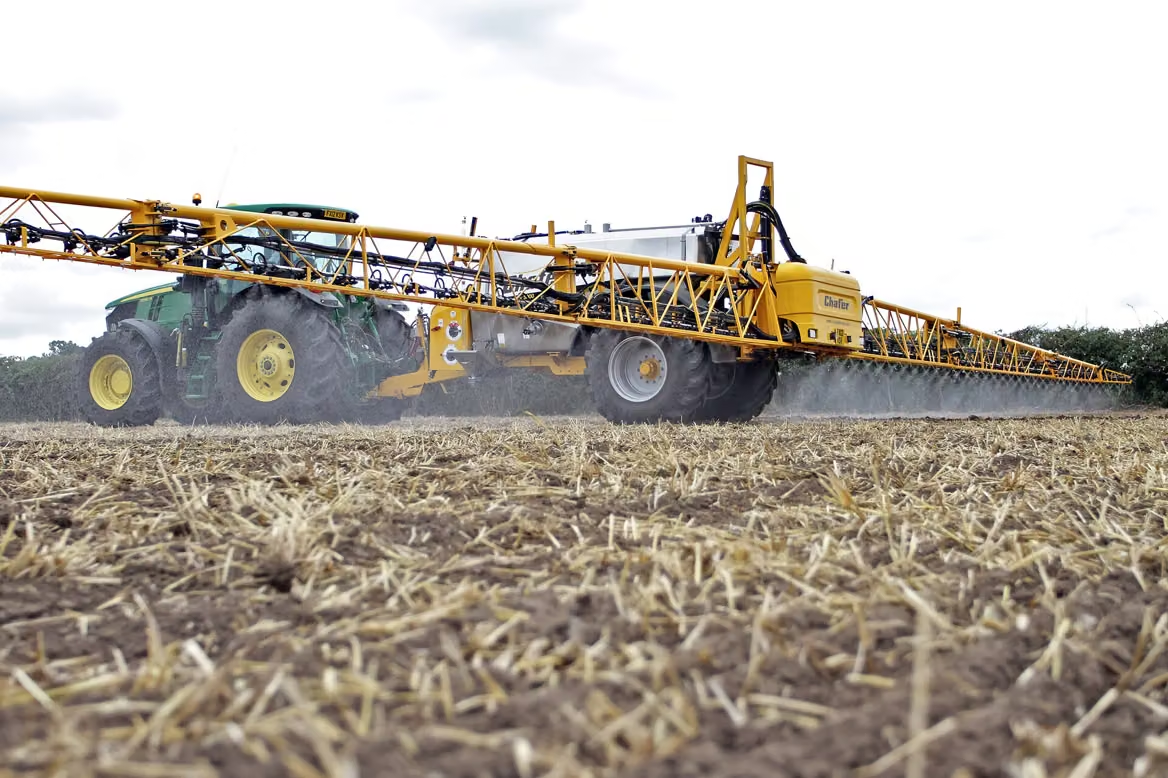
Paraquat is a weed killer. Farms and other businesses use it to control weeds and grasses, and to dry out crops such as cotton before harvest. It is often sold under the name Gramoxone.1
Today, every paraquat product sold in the United States is a restricted-use pesticide. Only trained, certified applicators may use it. There are no products for homeowners, and paraquat may not be used in residential areas.1
These rules have changed over time. Since EPA's 2016 safety changes, people working under a certified applicator's supervision may no longer use paraquat themselves. Before then, they could. So the rules in place today may not be the rules that applied when someone was exposed.1
Paraquat is also highly poisonous. EPA warns that one small sip can kill, and there is no antidote.1 That poisoning risk is a separate issue from the questions about Parkinson's disease discussed below.
Paraquat Exposure and Parkinson's Disease
Parkinson's disease is a disorder of the nervous system. It affects movement and gets worse over time. Common symptoms include shaking (tremor), stiffness, slow movement, and trouble with balance. Symptoms and how fast they change differ from person to person. Only a doctor can diagnose it.3
Scientists do not know the exact cause of Parkinson's disease. Most experts think it comes from a mix of genes and things in a person's environment.4
What the research says
Researchers have studied paraquat and Parkinson's disease for years, and the results do not all agree.
- A 2011 study of farmers and pesticide applicators reported that people who had used paraquat had about 2.5 times the odds of Parkinson's disease compared with people who had not.5
- A 2020 update from the same large farm study did not repeat that finding. EPA says the update reported no link between paraquat exposure and Parkinson's disease.16
- The National Institute of Environmental Health Sciences describes paraquat as one of several pesticides that its research has linked to Parkinson's disease.4
EPA's position is that it has not found a clear link between paraquat exposure from labeled uses and Parkinson's disease.1 Other scientists disagree, and the question remains disputed.
An association in a study is not proof of what caused one person's illness. A legal review also needs evidence about the product, the exposure, the person's medical history, and the law that applies. Read more in our article on understanding the paraquat research.
Exposure Histories That May Need Review
A review may involve people who:
- Mixed, loaded, or applied a product containing paraquat.
- Cleaned, maintained, or repaired equipment used to apply paraquat.
- Worked in fields where paraquat was used.
- Believe spray drift reached a nearby workplace or property.
Each of these situations calls for different evidence. Living near farmland, or working with weed killers, does not by itself show paraquat exposure. Identifying the product and showing how it was used are key parts of a review.
You do not need every answer before you contact us. Start with what you remember: where you worked, the years, your duties, and any product names.
What Paraquat Lawsuits Allege
People who bring a paraquat lawsuit allege that their exposure contributed to Parkinson's disease. Many also allege that the product warnings did not explain that risk. The companies dispute these claims.
These are allegations. They must be proven with evidence. Filing a lawsuit does not show that a company caused an injury or is legally responsible.
Federal paraquat cases are gathered before one judge in the Southern District of Illinois. This is called multidistrict litigation, or an MDL. The paraquat MDL is MDL No. 3004.7 An MDL handles shared pretrial steps together, but each person's claim still depends on their own facts. As of October 1, 2026, 6,602 cases were pending in the MDL, out of 8,495 filed since it began.13
The litigation has not gone one way. In April 2024, the court excluded the testimony of the plaintiffs' expert on whether paraquat can cause Parkinson's disease. It then ruled for the companies in the first four cases set for trial and dismissed them.1011 In February 2026, the companies asked the court to rule against all failure-to-warn claims in the pending cases.12
Paraquat Litigation and Settlement Developments
Court records confirm that the plaintiffs' lead lawyers and the companies signed a settlement agreement on September 3, 2025. It covers certain individual paraquat claims. The court paused trial preparation while the settlement process went forward.815
On April 8, 2026, the court ordered information about the settlement to be given to the court-appointed special master. That included who did not qualify, who turned down their offer, and who had not yet decided. The order says eligible cases were assigned to tiers with individual offers. It does not make settlement amounts public.8
The settlement does not mean every person exposed to paraquat qualifies for payment. It does not mean all paraquat litigation has ended. In June 2026, the court ordered limited discovery in selected cases where plaintiffs had turned down settlement offers.9
A settlement is not a verdict, and it is not an admission of wrongdoing. Do not assume an earlier settlement is open to new claims. Whether someone qualifies, which deadlines apply, and where a claim stands all need individual review. Read more in our article on what the court's settlement orders explain.
Records That Can Help Document Exposure
A useful exposure history ties together the product, the place, the work, and the years.
Records that may help include:
- Receipts, invoices, and supplier records for the product.
- Existing photos of product labels or containers.
- Pesticide application logs and farm records.
- Applicator licenses and training records.
- Employment records, job descriptions, and work schedules.
- Names and contact details for coworkers or supervisors.
- Maps or addresses of workplaces and treated fields.
- Records of spills, equipment problems, or exposure incidents.
- Neurology records showing the diagnosis and treatment.
The court's paraquat orders name proof of purchase, evidence of paraquat use, and applicator-license information as things that matter in discovery.9
If you do not have these records, tell us what you remember. A legal team can work out which records may exist and how to request them. Please do not guess or fill gaps with details you cannot confirm.
Preserve Records Without Creating New Exposure
Keep the documents, emails, photos, and medical records you already have. Save copies, and do not delete or change the originals.
Do not open, move, or handle paraquat or contaminated equipment just to collect evidence. Do not delay medical care or safety steps to save a product.
If a container or contaminated item is still at a workplace, ask a qualified professional how to handle and document it safely. Saving evidence should never create another exposure.
What a Paraquat Case Review May Consider
A paraquat attorney may look at:
- Whether the product contained paraquat.
- Where, when, and how exposure may have happened.
- How often, and for how long, the work or exposure took place.
- Purchase, application, and employment records.
- The diagnosis and relevant medical history.
- The state law and deadlines that may apply.
- Whether an existing case or the settlement affects the person's options.
No checklist guarantees that someone qualifies. These claims can raise hard scientific and legal questions. A review should rest on the person's real history and the evidence behind it.
Medical Costs, Work, and Daily Life
Parkinson's disease can affect a person's job, how they move, and everyday tasks. Families may take on new caregiving and household duties.
Depending on the claim and the law that applies, a legal review may consider medical bills, lost earnings, future care needs, and other documented losses.
No website can tell you what your case is worth. There is no guaranteed recovery, settlement amount, or timeline.
How CBW Law Can Help
Start by telling us about the diagnosis and the work or exposure you remember.
CBW Law can review what you share, point out questions that need more investigation, and talk with you about whether a fuller legal evaluation makes sense. If we offer to represent you, a written agreement will explain its scope and terms. You can read more about how we work.
You do not need a complete file to take the first step. A clear account of what you know is a good place to begin. Tell us your story, or call (800) 476-2416.
Recent Exposure or Possible Poisoning
If you think you or someone else was just exposed to paraquat or swallowed it, get medical care right away. Call 911 in an emergency, or Poison Control at 1-800-222-1222. Do not wait to hear back from a law firm.2
Medical information disclaimer: The medical and health information on this page is general information only. It is not medical advice, and it should not be used to diagnose a condition or make treatment decisions. Talk with a qualified health care professional about symptoms, exposure concerns, diagnosis, and treatment. Do not change prescribed treatment based on this page.
Questions
Paraquat questions
Short answers to common questions about paraquat, Parkinson’s disease, and the litigation.
Is paraquat the same as Roundup?
No. Paraquat and glyphosate, the active ingredient in many Roundup products, are different chemicals. Using Roundup does not show paraquat exposure, so identifying the product matters. We cover Roundup separately on our Roundup page.
Does Parkinson's disease mean I qualify for a paraquat lawsuit?
No. A diagnosis alone does not decide whether someone qualifies. The product, the exposure history, the medical evidence, deadlines, and other facts all need review.
Can I contact CBW Law if I do not remember the product name?
Yes. Tell us what you remember about your employer, duties, locations, suppliers, and years of work. Records may help identify the product, but exposure should not be assumed.
What if I lived near fields where paraquat was used?
Living nearby does not, by itself, show exposure or a claim. A review would need more information about the product, the spraying, the location, and how exposure could have happened.
Has there been a paraquat settlement?
Court records confirm a settlement agreement for certain claims, signed on September 3, 2025. That does not mean you qualify, that anyone can still join, or that every case has been resolved.
Is there a deadline to file?
Deadlines vary by state and by the facts. The date of diagnosis, when a possible connection was discovered, and other details can matter. Contact an attorney promptly for an individual answer. Sending a website form does not stop a filing deadline.
Can a family member contact CBW Law?
Yes. A family member can make the first inquiry. A fuller review may need the affected person's consent, or proof of legal authority to act for them.
Does contacting CBW Law make me a client?
No. Sending a form, calling, or sharing information does not create an attorney-client relationship. Representation begins only after the firm agrees to take the matter and a written agreement is signed.
Tell Us Your Story
If you or a family member was diagnosed with Parkinson’s disease after working with or around paraquat, CBW Law can listen to what happened and help decide whether it should be looked at more closely.
You do not need every record or exact date before you reach out. Tell us what you know, and we can start there. Contacting us does not create an attorney-client relationship.
Legal information disclaimer: This page provides general information, not legal advice. Exposure to paraquat or a Parkinson’s disease diagnosis does not automatically establish a legal claim. Eligibility, deadlines, and possible outcomes depend on individual circumstances and the law that applies. Past results do not guarantee future outcomes. Allegations in lawsuits are not findings of fact. Contacting CBW Law does not create an attorney-client relationship.
